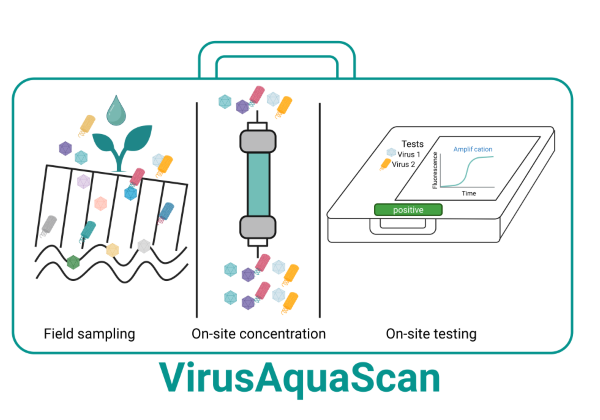
VirusAquaScan is a research and innovation project focused on the development and validation of a portable system for monitoring plant viruses in water samples used in agricultural production.
The project addresses the growing importance of water as a pathway for the dissemination of plant viruses and aims to develop innovative approaches for the concentration and detection of plant viruses in water. By combining expertise in plant virology, diagnostics, biotechnology, and engineering, the project aims to develop innovative solutions that can support sustainable agriculture and safe water management.
VirusAquaScan builds upon scientific knowledge, methodologies, and experiences generated within the previous ARIS-funded project TOBAMO (Discovery and water-linked epidemiology of emergent tobamoviruses infecting crops), which significantly improved our understanding of the occurrence, survival, and transmission of plant viruses in aquatic environments. The outcomes of TOBAMO highlighted the need for practical tools that would enable more efficient monitoring of virus risks associated with water used in agriculture. VirusAquaScan addresses this challenge by advancing research towards solutions with potential future application in routine monitoring and plant health management.
Project ID (ARIS): To be added
Duration: June 2026 – May 2028
Funding:
VirusAquaScan is co-financed by the European Union through the European Regional Development Fund (ERDF) under the Programme of the European Cohesion Policy 2021–2027 in Slovenia. The project is implemented within the framework of the ARIS public call “Upgrading ARIS Applied Projects (JP NAP)”
Project implementation:
Project partners: National Institute of Biology (NIB) and BIA d.o.o
Partner co-financing: BIA d.o.o


