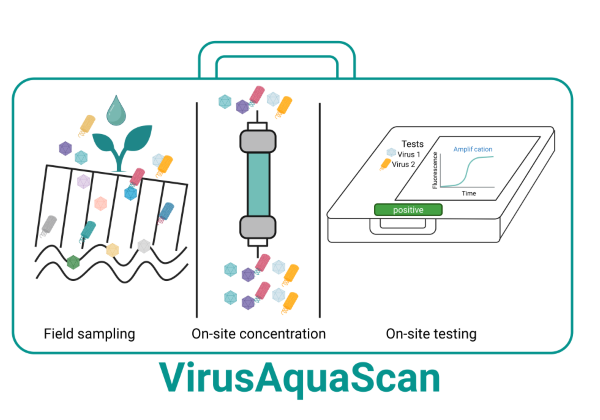
Phase 1: Understanding Virus Risks in Agricultural Water
The project builds upon previous research investigating the occurrence, survival, and dissemination of plant viruses in water used in agricultural production. This phase focuses on identifying key challenges associated with water-mediated virus transmission and defining requirements for improved monitoring approaches.
Phase 2: Development of Innovative Monitoring Solutions
The consortium develops and optimises innovative approaches for monitoring plant viruses in water samples. The work aims to improve the ability to detect viral contamination in water used for irrigation and other agricultural purposes while supporting future practical applications.
Phase 3: Evaluation and Validation
The developed solutions are evaluated and validated under laboratory and application-relevant conditions. The objective is to assess their reliability, robustness, and suitability for plant health monitoring and agricultural risk management.
Phase 4: Towards Practical Application
The project integrates research outcomes into a coherent solution with potential future use in agricultural and diagnostic settings. Activities support knowledge transfer, innovation uptake, and preparation for further development beyond the project lifetime.
Phase 5: Dissemination and Exploitation
Project results are communicated to scientific, professional, and wider audiences through publications, presentations, and outreach activities. Dissemination is conducted in accordance with confidentiality, intellectual property, and patent protection requirements.